
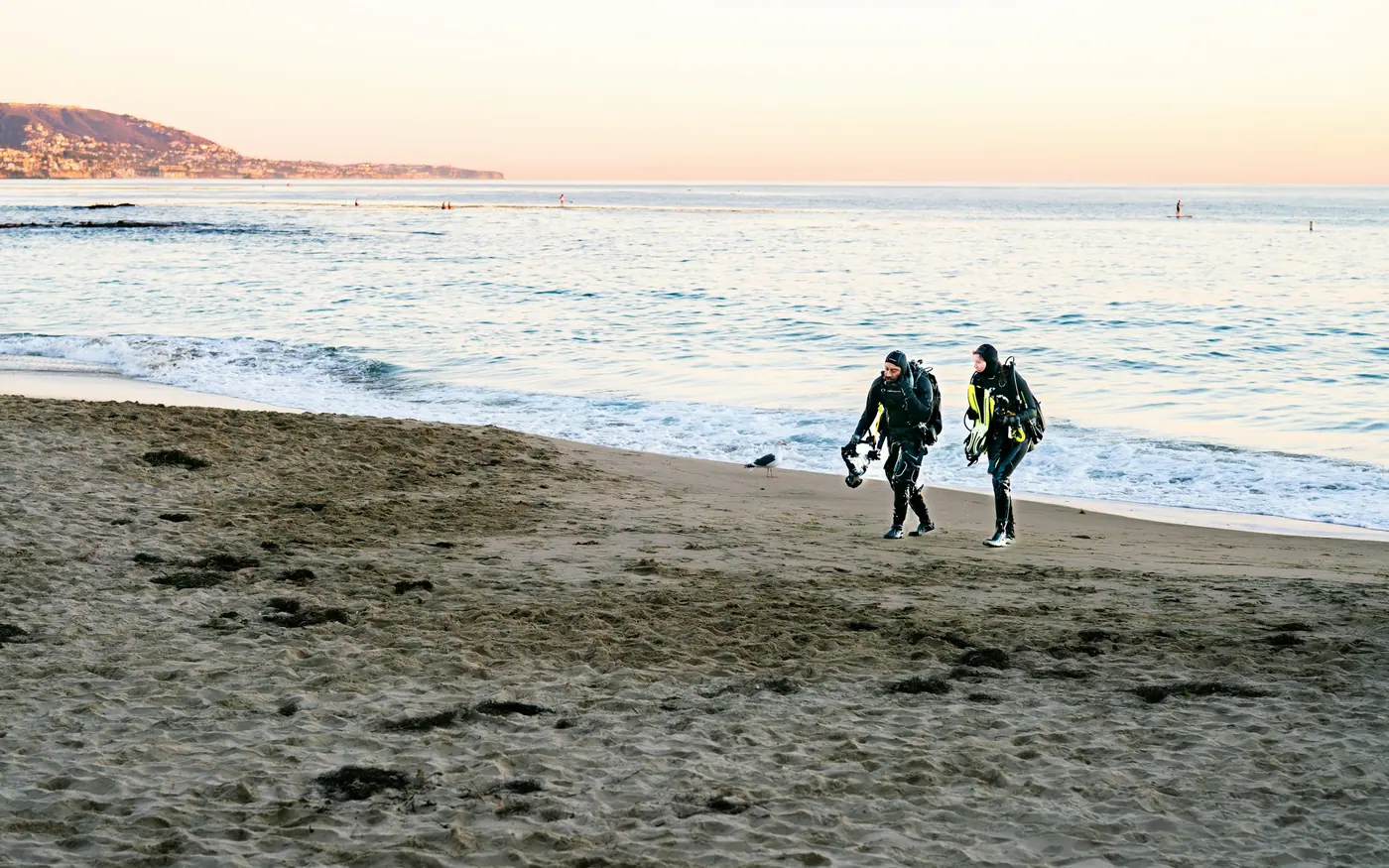
Almost nobody gets hurt diving. They get hurt walking. The awkward, weed-covered, ankle-turning ten yards between the parking lot and swimming depth is the genuinely hazardous part of a New England shore dive.

Look before you carry anything
The entry begins several minutes before you touch the water, standing on the shore doing nothing.
Waves arrive in sets, with larger and smaller groups alternating in a pattern you can see if you watch for five minutes. You are looking for the lull, and you are also looking for where you would come out, which is not always where you went in.
Five minutes watching the water is not a delay. It is the first part of the dive.
Decide the whole sequence on land: where you kit up, where you enter, where the exit is, and what you do if the exit is untenable when you get back. Whether the conditions justify any of it at all is the subject of reading conditions before a shore dive.
Getting in over sand
A sand beach with some surf is the textbook case, and the textbook works.
- Kit up fully on the beach, above the water line, with everything clipped and nothing dangling.
- Mask on and regulator in before you step in. Not once you are wet — a wave in the face with your mask on your forehead is how a mask gets lost.
- Carry your fins, do not wear them.
- Walk in backward, looking over your shoulder, so a wave hits your tank rather than your chest.
- Keep going to about thigh deep, past the break, then float and put your fins on.
- If a wave arrives early, turn sideways, bend your knees and lean into it. Do not try to stand tall against it.
Then swim out on the surface until you are clear, and descend. Do not try to descend in the break zone.
Getting in over rock, which is the local case

Most New England shore diving is not sand. It is granite with weed on it, and the weed is more slippery than it looks in every single case.
The rules change. You want three points of contact and complete balance before each step rather than a continuous walk. Hard-soled boots earn their money here, and so does a buddy going first and turning around to spot you.
Where there is a proper entry point — steps, a ladder, a slipway — use it even if it means a longer surface swim. A hundred yards of easy finning is a much better trade than thirty feet of scrambling in full gear.
And carry as little as you can while walking. Where the ground is genuinely bad, it is entirely reasonable to make two trips, or to hand gear down to somebody already in the water.
Steps, ladders and slipways

Where somebody has already built a way in, it is almost always the right answer, with two cautions.
The first is that steps and slipways are engineered for people, not for divers carrying eighty pounds of gear, and they are often coated in exactly the same weed as the rocks. The second is that a ladder is a one-at-a-time proposition both ways, and a queue of cold divers waiting at the bottom of one is its own small hazard.
Agree the order before you go in. It sounds fussy and it is a great deal less fussy than sorting it out at the end of the dive.
The exit, which is the harder half

Every source gives the entry more space than the exit and every experienced shore diver will tell you it is the wrong way round.
On the way out you are fresh, warm and unhurried. Coming back you are tired, cold, low on gas, and the conditions have had an hour to build. That is the combination that produces the injuries.
- Float and watch first. Hang off the exit for a minute and read the sets again before you commit.
- Keep your regulator in and your mask on until you are standing on dry ground.
- Take fins off at about waist depth, one at a time, keeping hold of them.
- Come out facing the sea where you can, or at least glancing behind you.
- Feet apart, knees bent, so the backwash cannot take your legs from under you.
- If you go down, stay down. Crawl forward on all fours, or kick back out to deeper water and try again. Standing up mid-wave is how ankles and knees get hurt.
DAN’s piece on shore diving is worth reading alongside this, and makes much the same point about the exit.
The unglamorous part nobody mentions

Shore diving is physical in a way boat diving is not, and most of the effort happens with your head above water.
Carrying a steel cylinder and a weighted 7 mm suit over uneven ground twice, in an hour, is a real load, and doing it while already overheated in neoprene is worse. Kit up as late as you sensibly can, walk slowly, and drink water — the dehydration that follows is one of the things that makes cold and cramp likelier.
It is also the strongest practical argument for not overweighting yourself, since every unnecessary pound gets carried across the rocks twice. That, and the diving reasons, are in how much weight you actually need.
Where to practice this

The way to get good at entries is to do easy ones in good conditions until the sequence is automatic.
Pick a benign site on a flat day and do it properly rather than casually: watch the water, kit up on land, mask and regulator on, walk in backward, fins past the break. Then do it again coming out. It is dull, it takes ten minutes, and it is what you will fall back on the day the conditions are less obliging.
Our shore diving guide and the Massachusetts North Shore pages cover which sites suit which conditions. If you are unsure about a particular entry, ask in the shop — somebody has done it, and they will tell you exactly where to put your feet.
Frequently asked questions
What is the safest way to walk into surf?
Backward, with your mask on and your regulator already in your mouth, looking over your shoulder. Keep going until you are past the break — usually around thigh deep — then put your fins on and swim.
When do I put my fins on?
Past the break, in water deep enough to float in, not on the beach. Walking in fins is how people fall over, and falling over in gear on rock is how people get hurt.
What do I do if a wave catches me?
Turn sideways to it, bend your knees, get low and lean into it. Presenting your side gives the wave less to push. If it knocks you down, do not try to stand up — crawl forward, or kick out to deeper water.
How do I get out over slippery rock?
Slowly, with three points of contact, and never with fins on. Hard-soled boots make a real difference. Get your balance fully before each step rather than moving continuously.
Is the exit really the dangerous part?
Usually, yes. You are tired, cold and the conditions have often built while you were under. Float for a minute and watch the sets before you commit to coming in.
Ask about the entry before you go
Local entries vary enormously and the knowledge is all in people rather than in guidebooks. Ask us about the site you are planning.