

On this coast, low visibility is not a bad day. It is the condition. Divers who learn to work with it dive year-round here. Divers who wait for clear water mostly stop diving.
What you are actually looking through
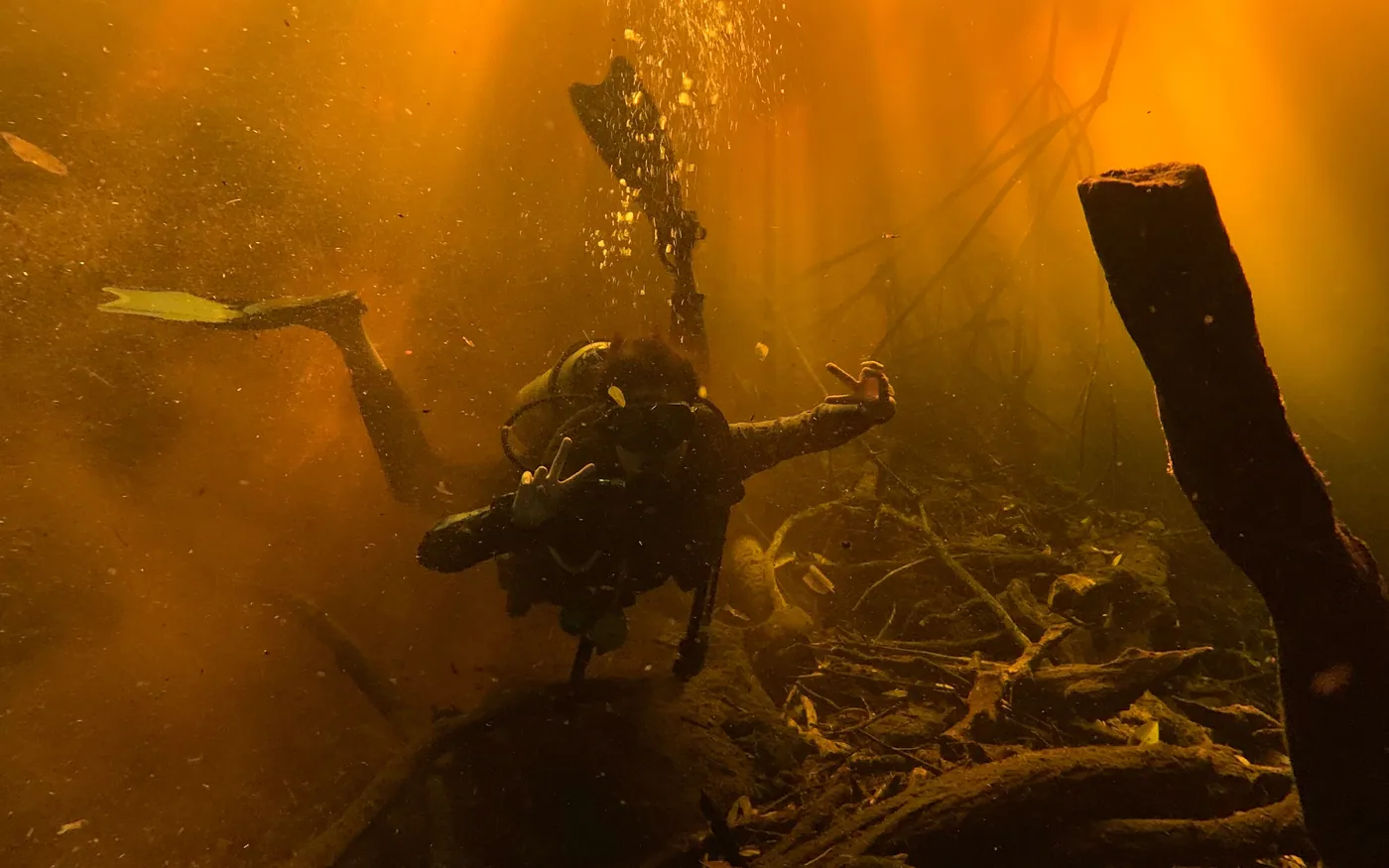
It helps to know that the green is not dirt. It is plankton, and it is the reason there is anything down there worth seeing.
That changes how you think about it. Clear water in this part of the world generally means a cold, unproductive stretch with less life in it. The murk and the marine life are the same phenomenon.
You are not looking through dirty water. You are looking through the food chain.
Sediment is a separate problem, and unlike plankton it is usually self-inflicted — which is the next section.
Most silt-outs are caused by the diver

The single biggest improvement most divers can make to their own visibility is to stop destroying it.
Quick or careless movements stir up the bottom, and once it is up it stays up for the rest of the dive. Move slowly and deliberately, keep your fins above the bottom rather than level with it, and stay off the seabed with your hands and knees.
This is really a buoyancy problem in disguise. A diver who can hold a position without touching anything keeps their own visibility, which is why the buoyancy dive is the one worth choosing on the Advanced course.
Staying with your buddy

The rule that matters most is the simplest: do not lose contact. In an emergency you still need to be able to communicate, and a buddy you cannot find is not a buddy.
- Dive closer than feels natural. In poor visibility that can mean within arm’s reach, continuously.
- Agree signals on the surface. “Are you OK”, “ascend”, “stop” — and agree what you will do if you separate.
- Use a buddy line if it is genuinely bad. Short enough to avoid entanglement, looped over a wrist rather than clipped tight.
- Supplement hand signals. Light signals work when hand signals do not, and a tank banger carries when nothing else does.
- Bright fins help. A yellow or orange fin is visible when a black one is not.
DAN sets out the safety case for these habits in more detail.
There is a psychological half to this as well, and it is worth naming. Poor visibility makes divers feel behind, and a diver who feels behind breathes faster, moves faster and stirs up more — which makes the visibility worse and confirms the feeling.
Breaking that loop is mostly a matter of deciding, before you get in, that the dive is going to be slow. A dive where you covered forty feet of rock properly is a better dive here than one where you swam two hundred and saw nothing.
Navigation stops being optional
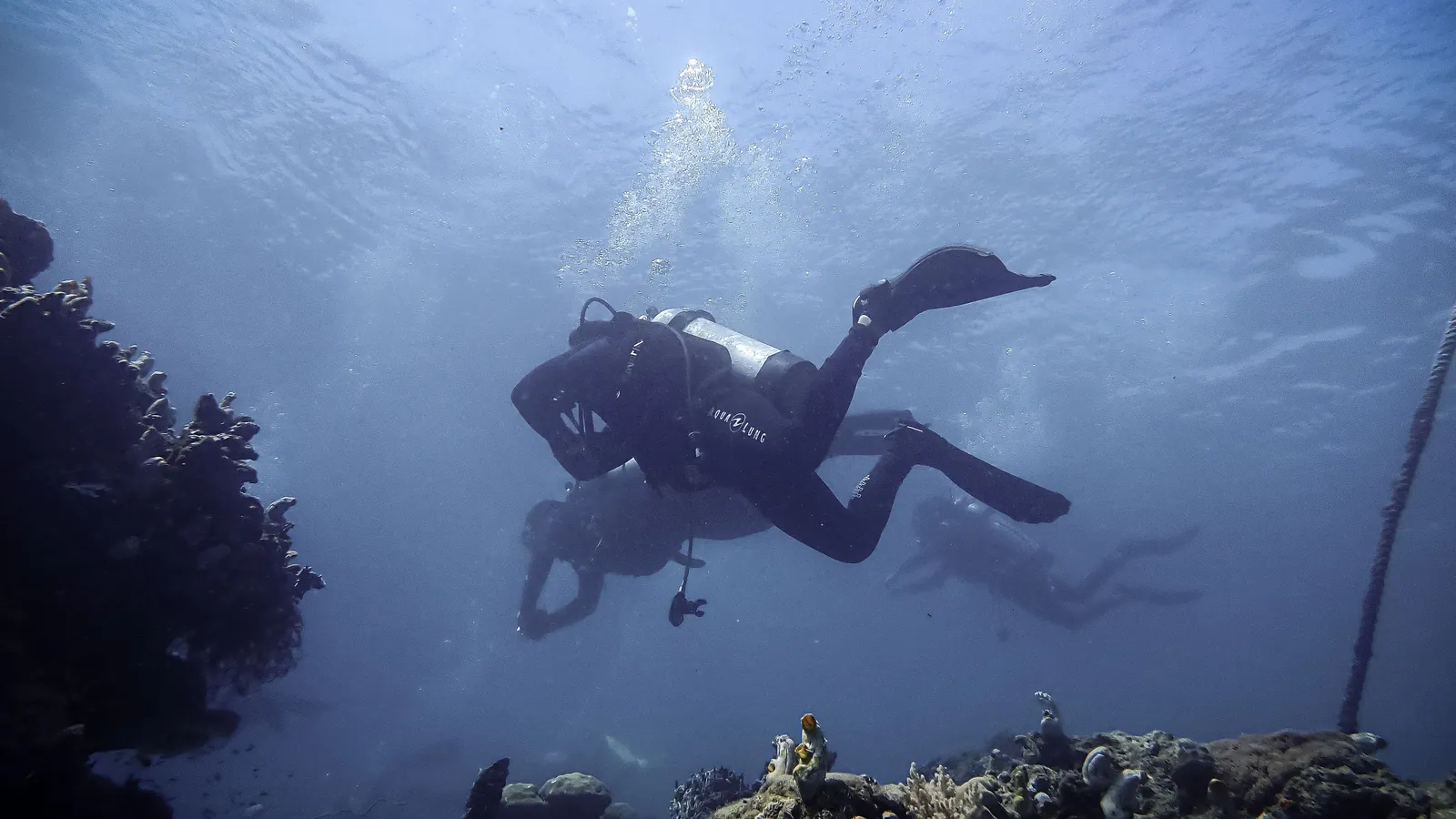
In clear water you can be a lazy navigator and get away with it, because you can see where you are going. Here you cannot.
Your compass skills have to be genuinely proficient rather than theoretically present, and the time to find that out is not the first time you surface a long way from your entry point.
The practical trick is to use edges. A jetty, a wall, a slope or a rock line gives you something to follow out and back without relying on the compass at all. That is why the jetty at Back Beach in Rockport makes such a good low-visibility site.
Planning around it
Some of this is technique and some of it is simply choosing better days, which is cheaper than any equipment.
Surge stirs the bottom, so a few settled days after a blow will do more for what you see than driving somewhere else. Later in the season generally improves as the spring plankton bloom settles out.
Tide matters at sites where a channel or a shallow flat empties past you. If you are unsure how a particular site behaves, ask someone who dived it last weekend — which is one of the underrated arguments for going out with a local divemaster rather than working it out alone.
What to change first
If low visibility is currently ending your dives early, the fixes are worth attempting in a specific order, because they are not equally effective.
| Change | Effort | What it improves |
|---|---|---|
| Slow down and lift your fins | Free | Your own visibility, immediately |
| Dive closer to your buddy | Free | Everything about how safe it feels |
| Agree signals and a lost-buddy plan | Five minutes | What happens when it goes wrong |
| Pick sites with a hard edge to follow | Planning | Navigation, almost entirely |
| Practice compass work in easy conditions | A dive | Confidence when you cannot see |
| Buy a light and bright fins | Money | Least of the five, honestly |
The order matters. Divers usually reach for the equipment first and the technique last, which is the opposite of where the returns are.
It is a skill, not a compromise
There is a reason divers trained in this kind of water are welcome anywhere. Buoyancy, navigation and buddy discipline all get tested constantly here, and they are exactly the skills that transfer.
Divers who certify locally arrive in clear tropical water and find it easy. It does not work the other way around, which is worth remembering on the days when you cannot see your own fins. If you have been out of the water long enough for those skills to have faded, a refresher is a better first step than a hard site.
Frequently asked questions
How little visibility is too little?
Less about the number than about whether you can keep contact with your buddy and know where you are. If you cannot see your buddy at touching distance, use a buddy line or call the dive.
Does a dive light help?
In dark water, yes. In a silt-out, often the opposite — the beam lights up the particles in front of you and makes it harder to see, the same way headlights do in fog. Carry one, and know when not to point it forward.
What is a buddy line?
A short rope connecting two divers, looped over the wrist or clipped to gear. Short enough to limit entanglement, long enough to let you both move. It is standard practice in genuinely poor visibility and there is nothing remedial about using one.
Why is New England water green?
Plankton, not sediment. It is the productivity that makes the diving worth doing — see what actually lives down there. It also means visibility improves later in the season as the spring bloom settles.
Should a new diver avoid low-visibility sites?
No, but pick them deliberately. A shallow site with a hard edge to follow — a jetty, a wall, a slope — is a good place to learn. Open sand in poor visibility is where people get disoriented.
Learn it here, dive anywhere
Divers Den has been teaching people to dive this water since 1968. Ask about buoyancy and navigation training, or come out on a local charter.