
The certification card is the least interesting thing that happened to you. What turns a certified diver into a diver is the twelve months afterward, and most of it is not courses.
The uncomfortable arithmetic
There is a pattern in diving that nobody puts on a course page, and it is worth naming plainly.
A large share of people who certify never dive much afterward. Not because they disliked it — because the certification finished, the group dispersed, and nothing was scheduled. Diving is unusually dependent on there being a next thing in the calendar, and for most people nobody puts one there.
The thing that ends most diving careers is not fear or cost. It is that nothing was booked.
So the single most useful thing you can do in your first month after certifying is book a dive. Any dive.
Three things to work on, in order
New divers usually have five complaints. They resolve into three problems, and the three are sequential.
| Work on | And these stop being problems |
|---|---|
| Weighting | Struggling to descend, bobbing at the stop, sinking onto the bottom |
| Trim | Finning the bottom, wrecking the visibility, working hard to stay level |
| Gas consumption | Being first up, feeling rushed, dreading the swim back |
The order matters because each one causes the next. An overweighted diver cannot trim, an untrimmed diver burns gas, and a diver worried about gas is tense, which burns more. Fix the first and the other two improve on their own.
What improves by itself, and what does not
Worth separating, because divers wait for things that are not coming.
Improves on its own, with dives: comfort, breathing rate, the general sense of not being a visitor. Twenty dives will do more for those than any amount of reading.
Does not improve on its own: anything you never practice. Navigation, mask clearing, regulator recovery, a second kick, deploying anything from a pocket. Divers with two hundred dives are routinely poor at all of these, because a dive does not make you do them.
The fix is small: spend five minutes of an ordinary dive on one of them. That is the entire difference between a diver who has done two hundred dives and a diver who has done one dive two hundred times.
Courses worth taking, and when
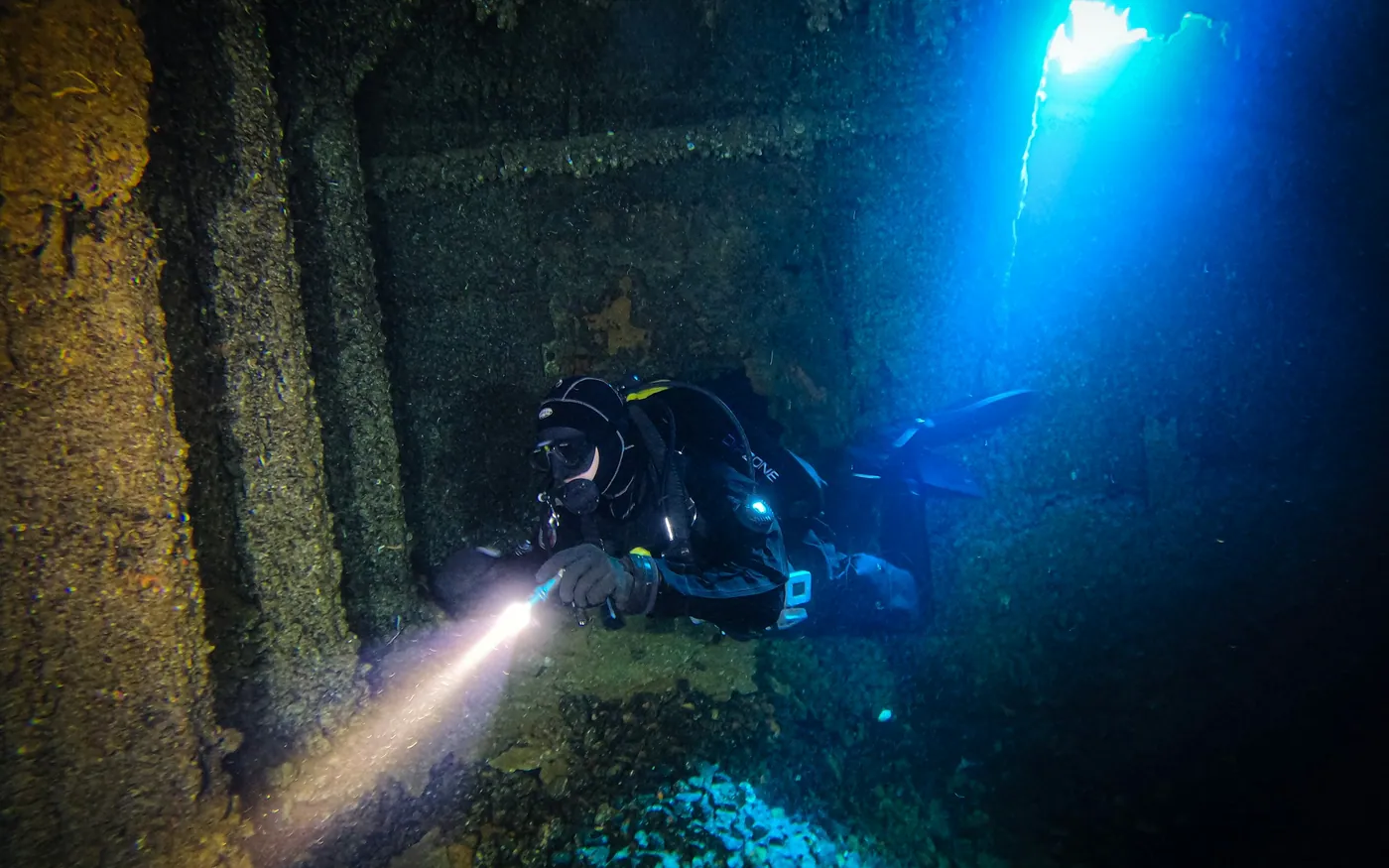
The honest ranking, from a shop that sells courses.
- Advanced Open Water, reasonably early. It covers depth and navigation, which are the two things that most limit where you can go — the case for it.
- Enriched air, if you dive more than once a day. Short, no dives required, and it changes multi-dive planning.
- Dry suit, if you mean to dive here year-round. It is the specialty that changes your calendar — see diving dry.
- Rescue, when you are comfortable enough that the dive is not occupying all your attention. Most divers name it as the course that changed them.
- Emergency oxygen and first aid, at any point. A day, no dives, and it makes you useful — the argument.
What is not on that list is a specialty taken because it was next. PADI has a reasonable summary of the habits worth keeping, none of which is a purchase.
Buying things, in a sensible order
Equipment is where new divers spend money fastest and get the least return.
The order that works is set out in your first set of gear: mask, then boots and fins, then a light, then an exposure suit once you know how cold you get, and the expensive life-support items only when you are diving often enough to justify servicing them.
A season of renting teaches you what you dislike, which is far more useful than a theory about what you might like. The divers who buy a full set in month two are frequently the ones selling it in year three.
The dives that teach you most
Not all dives are equally useful, and the pattern is not the one people expect.
The dives that develop a diver fastest are the slightly awkward ones close to home: cold water, limited visibility, a shore entry over rock, no guide. They are not the enjoyable ones to describe afterward, and they are where you learn to navigate, to manage a thick suit, to be calm when you cannot see far, and to make decisions without somebody leading you.
A week of warm guided diving is a wonderful thing and it teaches you comparatively little, because somebody else did the planning, the navigation and the judgment. Both are worth doing. Only one of them makes you self-sufficient, which is the argument in diving the same site again.
The part that actually decides it
If none of the above happens, one thing still will: whether you find people to dive with.
Local diving is a small world and it is almost entirely word of mouth. The fastest route in is a charter, where you spend a surface interval with people who dive this coast every week and who will tell you more in half an hour than a season of guessing. Shore diving with one reliable buddy is the other half.
Divers who find a group keep diving. Divers who do not, drift, however good their skills were at the end of the course. That is the whole of it, and it is worth knowing early enough to do something about.
A reasonable twelve months
If you want the year compressed into five lines: get in the water within a month of certifying, and keep the interval short after that. Fix your weighting early and write the numbers in a log. Do Advanced when depth or navigation starts limiting you. Buy a mask and rent everything else. And find two people you enjoy diving with.
Do that and the skills arrive on their own. Skip it and no amount of certification makes up the difference.
Frequently asked questions
How do I get better at diving?
Dive. That is not a joke and it is not evasion — the single strongest predictor of how good a diver becomes is how many dives they do in the first couple of years, and courses are a distant second.
Should I take another course straight away?
Only if there is diving you want to do that it opens. Advanced is genuinely useful because it covers depth and navigation. Beyond that, take a specialty when you want the diving — see what comes after Advanced.
What should I work on?
Weighting first, then trim, then gas consumption — and they are the same problem in three forms. Almost every other complaint a new diver has resolves once those three do.
How do I find people to dive with?
Charters and the shop. Local diving is a small community and the barrier is almost entirely that new divers do not ask.
What if I have lost confidence?
It is extremely common after a gap or a bad dive, and it is fixable in a morning rather than a season — that is what a refresher is for.
Book the next dive
The most useful thing after a certification is a date in the calendar. Ask us what is running locally.